
The upcoming GCARC End-Fed Half-Wave (EFHW) antenna build project date is almost here!
The Saturday, July 11, session is full.
Space is still available in the Saturday, July 18, session.
The cost per seat is $60.00 for the basic 250W version, $67.50 for the 750W version, and $75.00 for the 1500W version.
This build is a bit different from any that we have done before, in that each builder can select the band for which he/she wants to build.
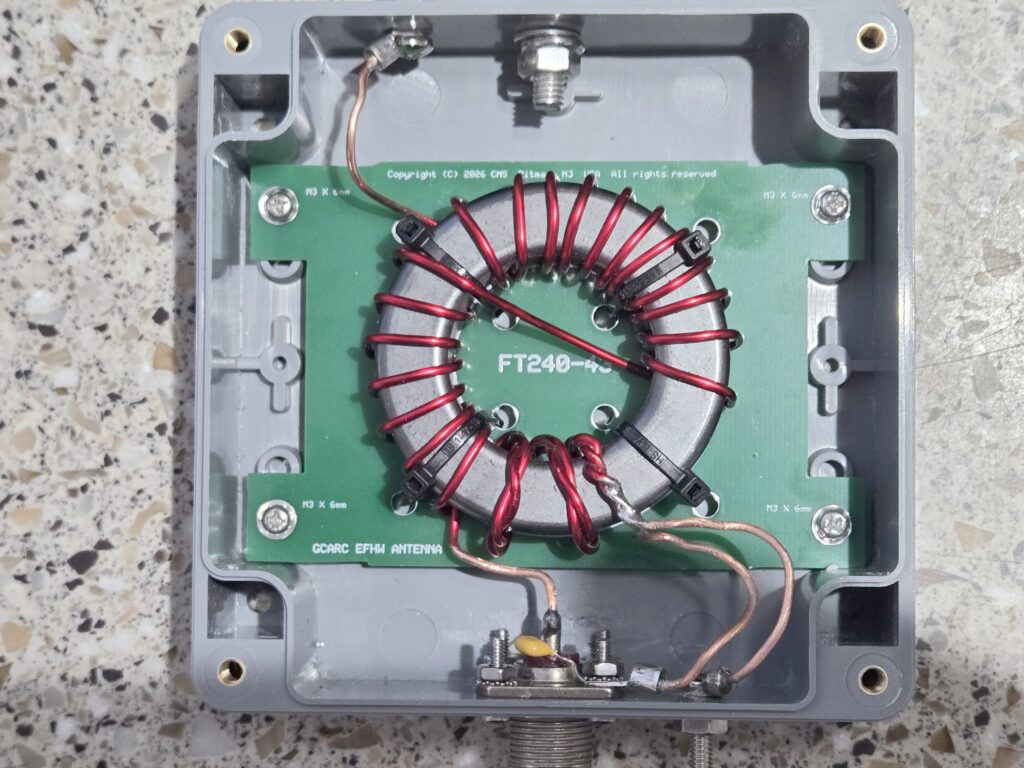
The photo above is an actual unit built under this plan.
This antenna project was originally intended to be an adjunct to the WSPR transmitter builds that we did a month or so ago. However, it was recognized that many members may simply want a nice moderate-power (or even high-power) antenna that is extremely simple to deploy. As a result, the design was modified to permit easy upgrade to 1500-watt capability.
The $60 price tag, while maybe seeming high, is still considerably less than the similar antenna kit offered by ARRL. Even the 1500-watt version of our antenna will come in under the $80 price tag (plus tax and shipping) for the ARRL EFHW kit… and the ARRL version is certainly not rated for a kilowatt and a half.
The heart of the antenna is the 49:1 impedance ratio transformer that connects the feedline to the radiator wire. This transformer is based upon an FT240-43 toroidal core (or two of them for the 1500-watt version) using heavy-build 14 AWG enameled magnet wire rated at 155°C. The transformer is enclosed within a 4-3/4″ square IP-65-rated weathertight and UV-stable plastic enclosure in a dark grey color. The enclosure will incorporate an SO-239 connector for the feedline attachment, and 8-32 studs with wing nuts for the radiator wire and counterpoise. Internally, the toroid(s) will be secured to a custom-made anchor plate, which in turn will be secured to threaded bosses in the floor of the enclosure. Finally, the enclosure will be equipped with a ring bolt used for hanging the box. Several colors of wire are available for the radiator. The radiator wire will be terminated with a “dogbone” insulator to aid in tying off the radiating element properly.
Give it some thought, and then if you decide that you can use such an antenna, sign up for the build by completing the form below…